Showing posts with label community. Show all posts

Tuesday, February 22, 2011

Life as a Meerkat - By Mark B. Johnson, MD, MPH

When I was in college I had the good fortune of living in Tanzania, East Africa, for a year. While there, I was occasionally asked to “guide” visitors through some of the world-famous national parks and game reserves in that area, including Serengeti, Lake Manyara, Amboseli (actually in Kenya) and the Ngorongoro Crater. Having the opportunity to observe the many varieties and species of animals in their natural habitat was an experience I will always treasure!
Serengeti National Park is famous for its vast plains covered with herds of migrating grassland antelopes, including wildebeests (gnus), hartebeests and various gazelle species. Several times while observing these animals we saw lions attack and kill one or two of the young or straggling members of the herds. What fascinated me at the time was how other antelope would watch curiously from a fairly close distance or nonchalantly graze near the kill site while the lions finished off their recently deceased colleagues. They seemed to sense that in this game of chance they were now safe.
I was reminded of this later when I lived in Los Angeles. The daily commute to work on the L.A. freeway system was also a community game of chance. We would all drive as fast as we could, sensing that sooner or later someone would get into a crash and we’d all have to stop and probably be late to our appointments. Then we’d curiously crawl empathetically around the crash site and speed off again on our important business, thankful, for the moment that we were safe.
With a highly probable impending disaster, no individual antelope or Angelino ever seemed to feel that they were going to be the next victim. There was no need to change behavior. After all, what are the odds of getting killed when there are thousands of other wildebeests around or 10 million other crazy drivers on the freeway?
It seems that we’ve built risk denial into many of our cultural rituals and even base public policy on it. For example, we know that there are individuals among us who cannot tolerate the use of alcohol, but we bet that it won’t be us or one of our family members, and therefore we joke about how much college students drink, glorify the use and abuse of alcohol on television and in the movies, and set policies around its sale and distribution that we know won’t really keep it away from the kids. Similar arguments could be made for such things as cigarettes, handguns, marijuana use, unprotected sexual activity and the use of bicycle or motorcycle helmets. We curiously, and perhaps empathetically, watch as the young or the stragglers are destroyed, but quickly speed off again on our important business as soon as we can.
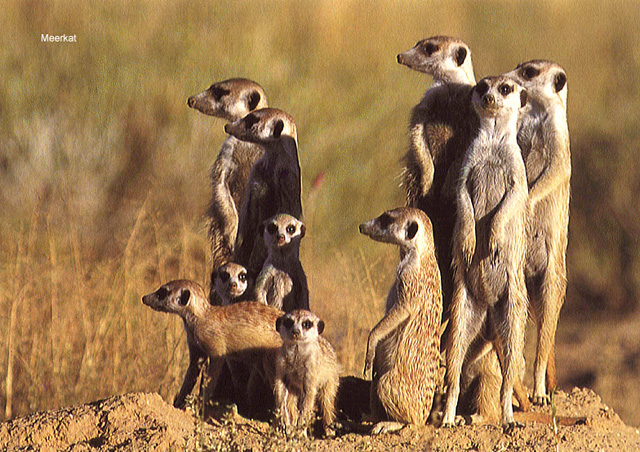
But there are animals on the African savannah that live differently, meerkats. Everybody loves meerkats. They are cute, cuddly-looking and very friendly, sociable animals. They’ve starred in at least two of their own movies (Meerkat Madness (2001) and The Meerkats (2008)), and have had their own television series on the Animal Planet network (Meerkat Manor and Meerkat Manor: the Next Generation (2005 – 2008)). Timon, one of the heroes in Walt Disney’s The Lion King movies, is a meerkat.
One of the most distinctive characteristics of meerkats, however, is their custom of assigning sentinels for their colonies. While the other meerkats are busy playing, exploring, hunting and gathering around the colony’s den, one or more of the adult meerkats stand at attention and scour the landscape for danger. When something unknown or threatening appears, they loudly signal the others to seek the safety of the colony’s shelter.
On June 15, 2009, in a speech at the annual meeting of the American Medical Association, President Barack Obama appealed to the physicians of this nation to join him in safeguarding the community by acting as medical sentinels. Part of his speech was directed at those of us in preventive medicine and public health: “Building a health care system that promotes prevention rather than just managing diseases will require all of us to do our parts. It will take doctors telling us what risk factors we should avoid and what preventive measures we should pursue…. Our federal government also has to step up its efforts to advance the cause of healthy living. Five of the costliest illnesses and conditions – cancer, cardiovascular disease, diabetes, lung disease, and strokes – can be prevented, and yet only a fraction of every health care dollar goes to prevention or public health. That’s starting to change with an investment we’re making in prevention and wellness programs that can help us avoid diseases that harm our health and the health of our economy.”

As I read the transcript of this speech, my mind went back to the meerkat sentinels on the Serengeti plains. They instinctively worked to prevent the injury and death of the members of their community. It’s funny, though – I don’t recall ever hearing anyone refer to those watchful lookouts as “do-gooders” or advocates of “nanny government.”

Friday, July 30, 2010

Building Health Care a Foundation


Health depends more on what you eat and drink, where you live, whether or not you have a job, how often you wash your hands, whether or not you smoke, how far you got in school, and where the factory next door dumps its waste than it does on high tech surgical procedures or the newest pharmaceutical drugs.

This is where public health fits in. Public health is the foundation of health care. As the Institute of Medicine has said, “The mission of public health is to fulfill society’s interest in assuring conditions in which people can be healthy.”

So how do the “conditions in which people can be healthy” relate to health care reform?

Let me give an example.

Let’s say two children are born on the same day, but in different communities. One is born to a mother who has carefully watched her diet throughout pregnancy and has abstained from alcohol and smoking. She lives in a village with pristine water and unpolluted air. The sewage and garbage in her village are transported far from town, where they are carefully processed and recycled. As she grows, her mother carefully teaches her about health and personal hygiene, and makes sure there is always plenty of nutritious food, soap and toothpaste in the house.

The second child is born a bit premature and is small for his age, due to his mother’s inadequate diet and heavy smoking throughout her pregnancy. He grows slowly because of his frequent coughs and bouts of gastrointestinal disease, and because he shares his limited nutrition with the hookworms he has acquired from running barefoot in the village. The water he drinks is questionable, and the air in his home is polluted from the coal-powered stove on which his mother cooks the meager fare which she is able to find in the marketplace. Outside, the stench is almost palpable from the garbage on the streets and the cracked and leaking sewage pipes. His mother knows little about hygiene, and is too busy with her other babies to teach him what she does know.

This exaggerated picture does have a message: It makes a big difference how much effort and the level of resources your community puts into assuring healthy conditions for you and your family. In fact, Dr. Herman Biggs, the Commissioner of Health for New York City in the late 1800s claimed, “Public health is purchasable. Within natural limitations a community can determine its own death rate.”

Now, if these two families came to buy health insurance from you, which would you prefer to insure? Before either child has even entered the “health care system,” you already know which one is going to have the highest health care costs. One has grown up in a community with a rock solid foundation of public health, and the other is attempting to survive in a community that is falling apart.

The choice is ours. “Within natural limitations, (we) can determine (our) own death rate.”

Tuesday, July 20, 2010

Treating STD's . . . A community Concern


I met your daughter’s boyfriend last night. Seems to have a good head on his shoulders. He says he wants to get into college on a football scholarship and plans on becoming an engineer. Nice kid. Good family. Bright future.

I felt bad I couldn’t do more for him, but you know how it is. With all the budget cuts lately, we really can’t afford to just give away medications in our sexually transmitted disease (STD) clinics. I’m sure he’ll come up with the funds somehow.

Seems funny now how things used to be. We used to get state and federal funds to treat kids like this. It had something to do with the old-fashioned concept that communicable diseases somehow impact the whole community. In fact, we were forbidden by the state legislature to charge for these services if the person couldn’t pay. How naïve we all were!

What a waste of money, trying to control things like syphilis, gonorrhea, tuberculosis, hepatitis and AIDS. Of course, we didn’t have things like HDTV plasma screen televisions to spend our tax rebates on in those days. I guess we could afford to be a bit more community minded back then.

But I wouldn’t worry too much if I were you. Like I said, your daughter’s boyfriend seems like a really nice kid. And I’m sure that “Just say, ‘No!’” lecture you gave her really sank in. It would be a real stretch to imagine she might be in that group of women (74%) who say they had sex before they turned 19. Besides, I’m sure he’ll come up with the money for the medications somewhere.